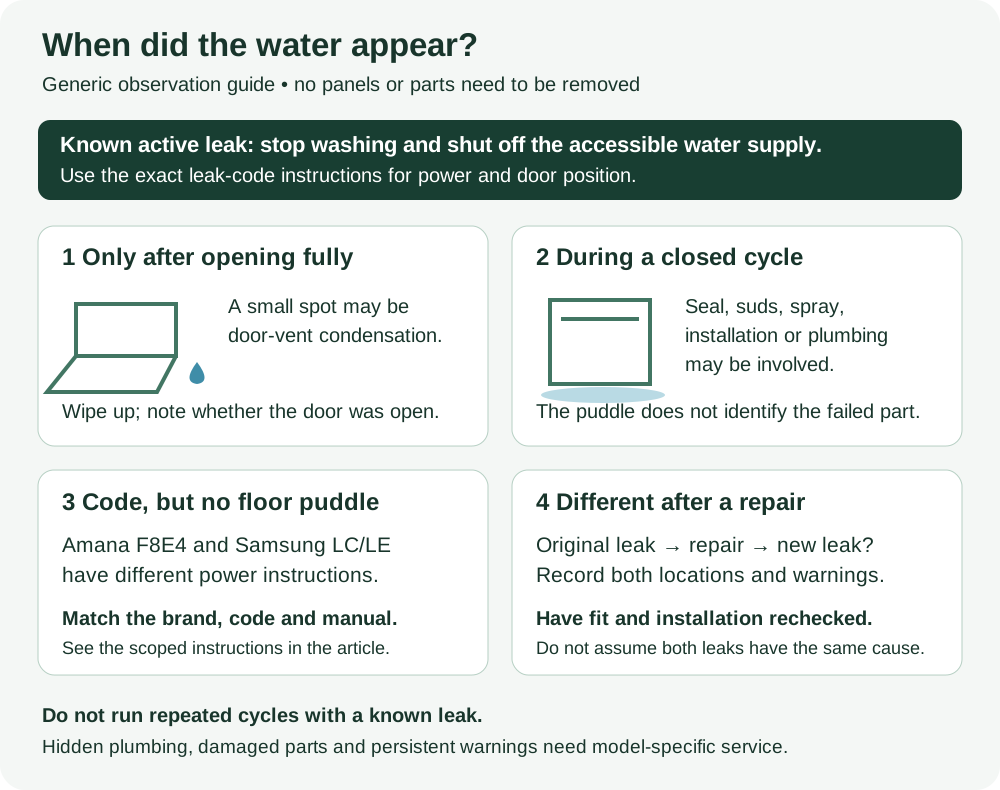
If your dishwasher is leaking water during a wash, stop using it and shut off its accessible water supply. A puddle at the door does not prove the gasket has failed: suds, spray, installation and hidden plumbing can also be involved. Check any leak code before choosing the power-off procedure, because some protective drain sequences need power and a closed door.
For an ordinary active leak without that model-specific exception, disconnect power at the correctly identified breaker before checking or cleaning. Stay away from wet electrical areas. Do not run repeated cycles to locate a known leak, pull out the machine, or remove its panels.
Did the water appear only after you opened the door?
A small spot that appears when you lower the door fully can come from condensation on the door vent. Amana's door-leak guidance describes this particular condition. It is different from water escaping while the dishwasher is closed and washing.
Wipe up the spot and note when it appeared. Do not replace a gasket based on that observation alone. Water already on the floor before the door opened, a growing puddle, or repeated wet cabinetry needs the leak checks below. The opening-related explanation does not rule out a separate leak.
Read the leak warning before resetting anything
Amana F8E4 during the protective drain
For a professionally installed Amana dishwasher covered by its F8E4 guidance, the drain sequence starts and normal operation is prevented. Turn off the water supply, press Cancel once to silence the alarm, and leave power on with the door closed while following that protective-drain instruction.
Contact the installer or service provider. Do not open the base to empty a tray or reconnect a switch yourself, and do not repeatedly clear the code to resume washing. This exception applies to that F8E4 instruction; it is not a rule for every leaking dishwasher. If there is an electrical hazard, keep clear and obtain urgent assistance.
Samsung LC or LE without visible water
Samsung LC/LE can indicate moisture where it should not be, even without a floor puddle. Its no-visible-leak procedure starts with power disconnected. Recent movement or excess detergent can be relevant; inspect accessible supply connections and shut off water if a leak is found.
Allow drying as the model guidance describes. A returning warning needs service. Do not transfer Amana's powered-drain instruction to Samsung, or treat a dry floor as proof that the sensor is faulty.
Water along the door: check three things
Door contact. With the machine stopped and safe to inspect, remove a utensil or dish obstructing closure. Wipe accessible dirt from the gasket gently with a damp cloth, using the cleaning method in the manual. A torn or displaced seal needs the correct model-specific remedy. Do not force the latch or add glue, packing or an extra strip of rubber.
Suds. Use only detergent labeled for automatic dishwashers, in the specified amount. Hand-dishwashing liquid or residue from prewashing can create foam that escapes the door. Stop adding detergent and follow the manufacturer's suds-removal directions.
A GE GSD3300R20WW owner reported that a replacement seal did not stop front leakage. Cleaning, rinses and a detergent change were followed by an improvement. Because several things changed, that history does not establish which one worked or prove that a particular detergent was defective.
Spray and loading. A pan or utensil can obstruct an arm, while a blocked jet or damaged arm can redirect water toward the door. Check visible clearance with power off; clean only the openings and parts the manual permits. Stop if an arm is cracked or will not move freely.
On one Frigidaire FGIP2468UF0A, replacing the lower seal and then the door seal failed to stop the leak; a whole spray-arm replacement reportedly did. An earlier repair had replaced only a blue component of the arm. Those are different repairs, and neither result identifies the failed part in another dishwasher.
After installation, check alignment as well as level
Have the installer confirm that the machine is supported properly and level in both directions. Flooring changes or a machine pushed back into its opening can warrant a fresh installation check. Do not lean it backward as a way to hide water escaping at the front.
A level reading does not establish that the tub opening is undistorted. Samsung describes cabinet screws pulling the sides outward when overtightened. Ask the installer to check mounting and tub shape against the exact installation guide; a tighter screw is not necessarily a better seal. Do not apply another model's opening dimension to yours.
A Frigidaire FFCD2413UB1A owner still had a right-front leak after both seals were replaced. A technician then reported frame and tub damage, and replacement of the dishwasher was planned. A completed replacement was not reported. This is a reason to investigate alignment or damage when seals do not help, not a diagnosis from the puddle's position.
Still leaking after a seal was replaced?
Separate the original leak from what changed immediately after the repair. Give the installer the old and new leak locations, the original warning, and the exact replacement part. Ask for the part's fit, seating and orientation to be checked against the model instructions before another component is ordered.
A Bosch SHXM98W75N/11 owner initially had intermittent E15. After both seals were changed, front-corner leaks appeared; further wand and lock work did not settle them. The owner later corrected the tub-seal orientation and reported more than ten cycles without the final leak. The cause of the original E15 remained uncertain.
That sequence matters: the final leak may have followed a different path from the first one. It does not establish a universal direction for fitting Bosch gaskets. Have the repair checked; do not flip a seal by guesswork or run leaking cycles to reproduce someone else's result.
Water underneath or beside the machine
With water and power safely isolated, look only at plumbing already accessible without moving the dishwasher. Moisture at an under-sink supply or drain connection is useful information for the installer. Do not loosen a pressurized fitting or reach behind electrical parts.
Water from beneath the cabinet can also involve internal hoses, a sump, a pump seal or a tub fault. The place where it reaches the floor is not enough to choose among them. Those checks belong to service.
If the main observation is substantial water left inside after a cycle, use the dishwasher not draining guide for permitted filter and drain-path checks. Keep the machine out of use while an external leak remains.
Water appears inside while the dishwasher is off
That is a different starting point from a door leaking during washing. Unexpected refilling can involve the inlet or water returning through the drain connection. Record whether the water is clean or dirty and whether sink use preceded it, then use dishwasher fills with water when off. Do not assume a new door seal will resolve it.
What to send with a service request
Send the model number, exact warning or flashing-light pattern, and a photo of the water's first visible location if you already have one. Include whether the door was open or closed, the stage of the cycle when you noticed it, and any recent installation, plumbing or seal work.
Keep attempted changes in order, including what failed and what changed afterward. A dry floor after clearing an alarm is not a completed repair. Persistent leakage, damaged seals or arms, distorted parts, or a source hidden behind panels calls for service before normal use resumes.
Official references
- Amana: door leakage and opening-related condensation
- Amana: F8E4, including the professionally installed protective-drain instruction
- Samsung: visible leaks and LC/LE without a visible leak
- Amana: leveling and a square installation
- KitchenAid: leak checks and service boundaries
- Whirlpool: supply, drain, door and detergent checks